

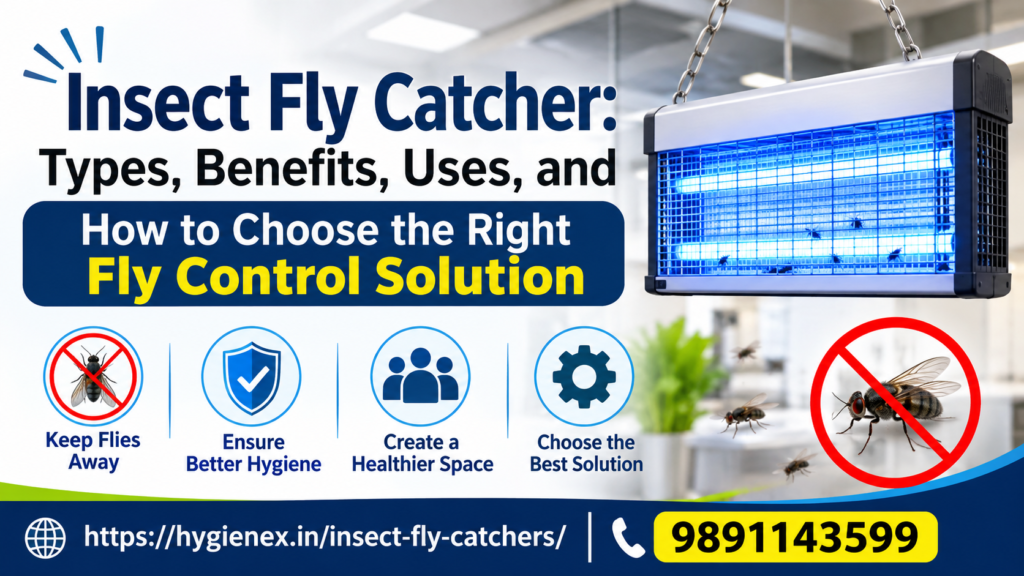
Flies are more than a nuisance. A single housefly can carry bacteria from garbage, drains, and waste onto food-preparation surfaces within minutes. For restaurants, hospitals, food factories, and warehouses, even a small fly problem can lead to failed audits, contaminated products, and a damaged reputation. This is where an insect fly catcher becomes an essential part of a hygiene plan.
An insect fly catcher is a device designed to attract, trap, and eliminate flying insects such as houseflies, mosquitoes, moths, gnats, and midges. Instead of relying only on sprays and chemicals, it uses light, glue, or electric technology to control insects continuously and safely. This guide explains how these devices work, the main types available, their benefits and applications, and how to choose the right fly control solution for your space.
What Is an Insect Fly Catcher?
An insect fly catcher is a pest control device that lures flying insects towards a trapping surface or an electrified grid. Depending on the design, it may be called a fly catcher machine, insect killer machine, or UV insect trap. The goal is the same: reduce the population of flying insects without exposing food, people, or equipment to harsh chemical sprays.
These devices are widely used in homes, shops, kitchens, hotels, hospitals, and industrial units. In regulated sectors such as food processing and healthcare, they are often a standard requirement in hygiene and pest management programmes.
How Does an Insect Fly Catcher Work?
Most modern units rely on one simple fact: many flying insects are strongly attracted to ultraviolet (UV) light. The working process generally follows three steps:
- Attraction: UV lamps emit light in the wavelength range that flying insects find most appealing, especially in dim or indoor settings.
- Capture or elimination: Insects approach the light and either land on a glue board placed behind the lamp or touch a high-voltage grid that kills them instantly.
- Collection: Dead insects remain on the glue board or fall into a collection tray, which is cleaned or replaced during routine maintenance.
Some units use pheromone or food-based attractants, while others combine light with a fan or suction system to pull insects in. The right method depends on the insect species and the environment.
Types of Insect Fly Catchers
Choosing the best option starts with understanding the main categories available.
UV Light Insect Fly Catchers
These are the most common choice for indoor commercial spaces. UV lamps attract insects towards a glue board or trapping surface. Because there is no electric grid, there is no risk of insect fragments scattering, which makes them especially suitable for food-handling areas.
Best for: kitchens, restaurants, bakeries, cafés, and retail stores.
Electric Fly Catchers
An electric fly catcher attracts insects with UV light and kills them with a high-voltage grid. They are effective and fast-acting, and they usually come with a removable tray for dead insects. Placement matters, because fragments can fall near open food if the unit is installed carelessly.
Best for: storage areas, entrances, waiting areas, and spaces away from open food.
Glue Board Fly Catchers
A glue board fly catcher captures insects on an adhesive sheet, usually positioned behind UV tubes. It is quiet, electricity-light, and hygienic because insects stay stuck to the board rather than shattering. Glue boards also give a useful record of what species are present, which helps with pest audits.
Best for: food processing, hospitals, hotels, and sensitive environments.
Fly Trap Machines
Fly trap machines are compact units, often wall-mounted or standing, that combine attractants and traps in one body. They suit smaller commercial areas where a discreet and easy-to-maintain device is preferred.
Best for: small shops, offices, clinics, and reception areas.
Industrial Insect Control Machines
Heavy-duty units are built for large halls, factories, warehouses, and processing plants. They use higher-wattage UV lamps, stronger housings, and larger capture areas to cover big spaces and withstand dust or humidity.
Best for: factories, warehouses, cold storage, packaging units, and large kitchens.
Comparison of Insect Fly Catcher Types
| Type | Method | Typical Coverage | Best For | Key Advantage | Consideration |
| UV light insect fly catcher | UV attraction + glue or trap | Small to medium areas | Kitchens, cafés, shops | Safe near food, quiet | Lamps need periodic replacement |
| Electric fly catcher | UV attraction + high-voltage grid | Medium areas | Entrances, storage, waiting areas | Fast, strong kill rate | Careful placement needed near food |
| Glue board fly catcher | UV attraction + adhesive board | Small to large (by model) | Food units, hospitals, hotels | No insect fragments, easy monitoring | Boards must be changed regularly |
| Fly trap machine | Attractant + trap | Small areas | Offices, clinics, small shops | Compact and simple | Limited coverage |
| Industrial insect control machine | High-wattage UV + large capture area | Large halls and plants | Factories, warehouses | Durable, wide coverage | Higher upfront cost |
Key Benefits of Using an Insect Fly Catcher
A well-chosen insect fly catcher delivers value well beyond removing visible flies.
- Improved hygiene: Fewer flying insects means fewer contact points between waste and food surfaces.
- Effective fly control: UV attraction works around the clock, catching insects that sprays often miss.
- Reduced contamination risk: Flies are carriers of bacteria such as E. coli and Salmonella. Controlling them helps protect products and customers.
- Chemical-free operation: Light and glue-based methods avoid the residues and odours of aerosol insecticides.
- Convenience: Most units are plug-and-play and need little supervision.
- Low maintenance: Routine tasks are limited to glue board changes, tray cleaning, and lamp replacement.
- Audit readiness: Glue boards provide evidence of pest activity, supporting food safety and quality audits.
Where Insect Fly Catchers Are Used
The same technology adapts well across very different settings:
- Restaurants and kitchens: Protect food preparation zones, serving areas, and dining spaces.
- Hotels: Keep lobbies, banquet halls, and pantries free of flying insects.
- Hospitals and clinics: Support infection control in wards, sterile storage, and canteens.
- Food processing units: Meet hygiene standards in production, packing, and dispatch areas.
- Warehouses and cold storage: Prevent insects from entering through loading bays and doors.
- Factories and manufacturing plants: Protect finished goods and maintain clean work areas.
- Supermarkets and retail stores: Control insects near fresh produce, bakery, and meat counters.
- Homes and offices: Provide a quiet, chemical-free way to reduce flies and mosquitoes.
This breadth of use makes the insect fly catcher one of the most versatile tools within commercial fly control solutions.
How to Choose the Right Insect Fly Catcher
No single device suits every space. These factors help narrow the decision.
Coverage Area
Manufacturers specify the area a unit can cover. A compact device in a large hall will underperform, while an oversized unit in a small kitchen wastes money. Measure your space and add units for long or divided layouts.
UV Light Technology
Look for lamps with the right UV-A wavelength for flying insects and a reliable output over time. UV tubes lose intensity with use, so check the recommended replacement interval, typically every 8 to 12 months.
Glue Board Quality
Strong adhesive, good coverage, and a design that resists dust are important. Poor-quality boards dry out quickly and lose catching power.
Installation Location
Placement determines performance as much as the machine itself. Good locations include entrances, near waste areas, and corridors leading to food zones. Avoid placing units directly above open food or in strong competing light.
Safety
Check that the unit has protective guards, insulated wiring, and quality housing. In food areas, glue-based or shatter-resistant designs are generally safer.
Energy Consumption
UV units typically consume little power, but running many units continuously adds up. Efficient lamps and well-chosen wattage help control costs.
Maintenance Requirements
Consider how easily you can access the lamp, tray, and glue board. A device that is hard to service often ends up neglected.
Which Model Suits Which Requirement?
| Requirement | Suitable Option | Why It Fits |
| Small restaurant or café | Compact UV glue board unit | Quiet, safe near food, easy to maintain |
| Hotel kitchen and banquet area | Medium UV glue board fly catcher | Balanced coverage and hygiene |
| Hospital or clinic | Glue board fly catcher | No fragments, supports infection control |
| Food processing plant | Industrial UV glue board machine | Meets hygiene audits, wide coverage |
| Warehouse or loading bay | Industrial insect control machine or electric unit | Handles large, open, high-traffic spaces |
| Retail store or supermarket | UV insect trap with glue board | Discreet, effective near fresh produce |
| Office or home | Compact fly trap machine | Simple, low-noise operation |
For a wider range of options across these categories, you can explore the Hygienex insect fly catchers collection to compare models by size and application.
Installation and Maintenance Best Practices
Even the best insect fly catcher needs proper setup and care.
- Install at the right height: For flies, mount units roughly 1.5 to 2 metres above the floor, away from competing light sources.
- Place near entry points: Position devices where insects enter, not directly beside food.
- Clean trays regularly: Remove dead insects to maintain hygiene and avoid odours.
- Replace glue boards on schedule: Change them when about 60 to 70 percent of the surface is covered, or earlier in heavy infestation seasons.
- Replace UV lamps annually: Lamps may glow visibly but still lose their attraction power.
- Keep a service log: Record dates and catch counts to spot patterns and support audits.
- Support with good sanitation: Fly catchers work best alongside proper waste handling, sealed bins, and clean drains.
Common Mistakes to Avoid
Many disappointing results come from avoidable errors:
- Buying by price alone: The cheapest unit often has weak lamps and poor glue boards.
- Ignoring coverage area: Undersized units cannot protect large spaces.
- Installing in the wrong spot: Placing a unit near windows or beside bright lights reduces its pulling power.
- Positioning above food: This risks contamination, especially with electric models.
- Skipping lamp replacement: Worn-out UV tubes quietly reduce effectiveness.
- Neglecting maintenance: Overloaded boards and full trays stop working properly.
- Relying on the device alone: Sanitation and structural proofing remain essential.
Frequently Asked Questions (FAQs)
1. What is an insect fly catcher and how does it work?
An insect fly catcher is a device that attracts flying insects using UV light and then captures them on a glue board or kills them with an electric grid. It works continuously and avoids the need for spraying chemicals.
2. Is an insect fly catcher safe to use in kitchens?
Yes, when the right type is selected. Glue board and UV light models are widely preferred in food areas because they do not scatter insect fragments. Install them away from open food and preparation surfaces.
3. What is the difference between an electric fly catcher and a glue board fly catcher?
An electric fly catcher kills insects through a high-voltage grid, while a glue board fly catcher traps them on adhesive. Glue boards are generally better for hygiene-sensitive areas, while electric units suit entrances and storage spaces.
4. How often should glue boards and UV lamps be replaced?
Glue boards usually need changing every few weeks, or sooner when heavily covered. UV lamps are typically replaced once a year, because their output drops even when they still appear to glow.
5. Where should I install an insect fly catcher?
Place it near entry points, waste areas, and corridors leading to food zones. Keep it away from open food, direct sunlight, and strong competing light sources.
6. Can an insect fly catcher eliminate flies completely?
It greatly reduces the number of flying insects but works best as part of a broader strategy that includes cleanliness, proper waste management, and sealing entry points.
7. How do I choose the right insect killer machine for my business?
Start with your space size, the type of insects, and the level of hygiene your industry requires. Then compare UV output, glue board quality, safety features, and maintenance needs, or ask a supplier for a site-specific recommendation.
Conclusion
An insect fly catcher is a practical, low-maintenance way to protect hygiene, food safety, and customer confidence. Whether you run a small café, a hospital, or a large manufacturing plant, the right combination of UV technology, glue board quality, correct placement, and consistent maintenance can make a measurable difference to your fly control results.
If you are looking for a dependable insect fly catcher supplier, Hygienex offers a range of insect control solutions designed for residential, commercial, and industrial needs. Visit hygienex.in to explore the products, or speak to the team for help selecting the right model for your space.
Get In Touch
- Website: https://hygienex.in/
- Phone: 09891143599
- Email: info@hygienex.in
- Address: Kundli, Sonipat,